


Image

Summary
Dubai has strengthened its position as one of the world’s most advanced urban centres, securing 6th place globally and 1st regionally in the 2026 IMD Smart City Index. The latest ranking reflects the emirate’s continued progress in digital transformation, artificial intelligence, smart mobility, and citizen-centric governance.
Compiled annually by the International Institute for Management Development (IMD), the Smart City Index evaluates how cities use technology to improve residents’ quality of life. Dubai’s performance highlights its ability to translate innovation into everyday benefits for residents and businesses, reinforcing its status as a leading Dubai smart city.
Table of Contents
What Is the IMD Smart City Index?
The IMD Smart City Index is a globally recognised benchmark published by the IMD Smart City Observatory. It assesses how effectively cities integrate technology into urban life to improve accessibility, efficiency, and overall liveability.
Unlike traditional infrastructure-focused rankings, the smart city index places strong emphasis on residents’ perceptions. This means the evaluation is not only based on technological deployment but also on how people experience services such as transport, healthcare, governance, and digital platforms in their daily lives.
The index has become an important indicator of urban competitiveness, helping cities measure progress in digital transformation and identify areas for improvement in creating smarter, more connected environments.
Top 10 Smart Cities in the World in 2026
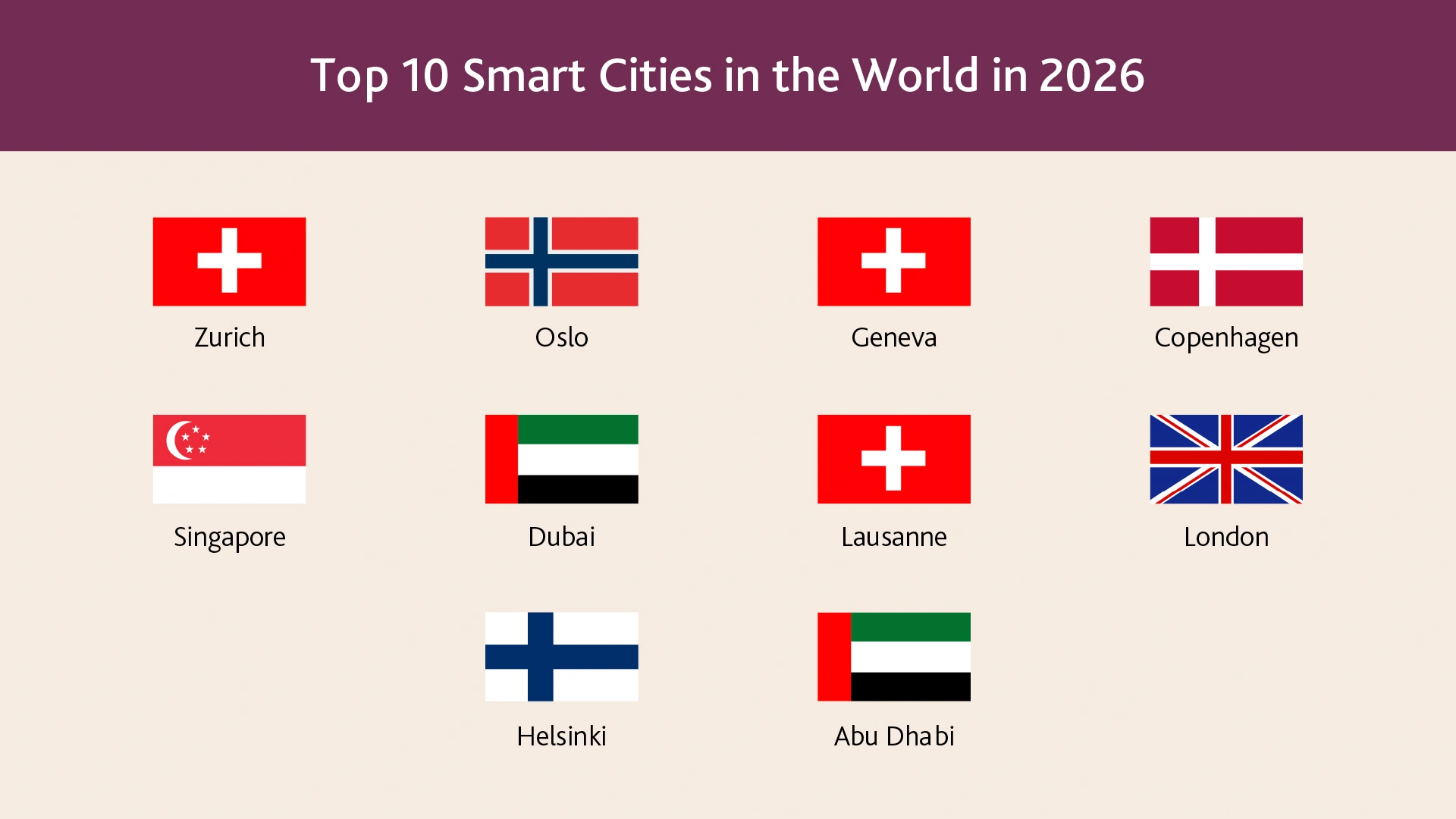
The 2026 rankings highlight the growing competition among global cities to lead in innovation, sustainability, and digital governance. Dubai’s position among the top six cities globally reflects its continued rise as a world-class smart city.
Why Dubai Is One of the World’s Leading Smart Cities
Dubai’s rise in the smart city index is the result of long-term planning, strong leadership, and continuous investment in digital infrastructure and innovation. The city has built a model where technology directly enhances quality of life and economic competitiveness.
Dubai has developed one of the world’s most advanced digital government ecosystems. Through integrated platforms and paperless initiatives, residents can access hundreds of government services online without physical visits. This shift has significantly improved efficiency, transparency, and user experience across public services.
Mobility is a key pillar of Dubai’s smart city strategy. The city continues to expand its public transport network, including the Dubai Metro, buses, marine transport, and smart taxi systems. Advanced traffic management technologies and contactless payment solutions further enhance connectivity and reduce travel friction across the emirate.
Artificial intelligence plays a central role in Dubai’s transformation strategy. AI is integrated across government services, urban planning, and customer experience platforms. This enables faster decision-making, predictive analytics, and more personalised public services, supporting Dubai’s ambition to become a global leader in AI adoption.
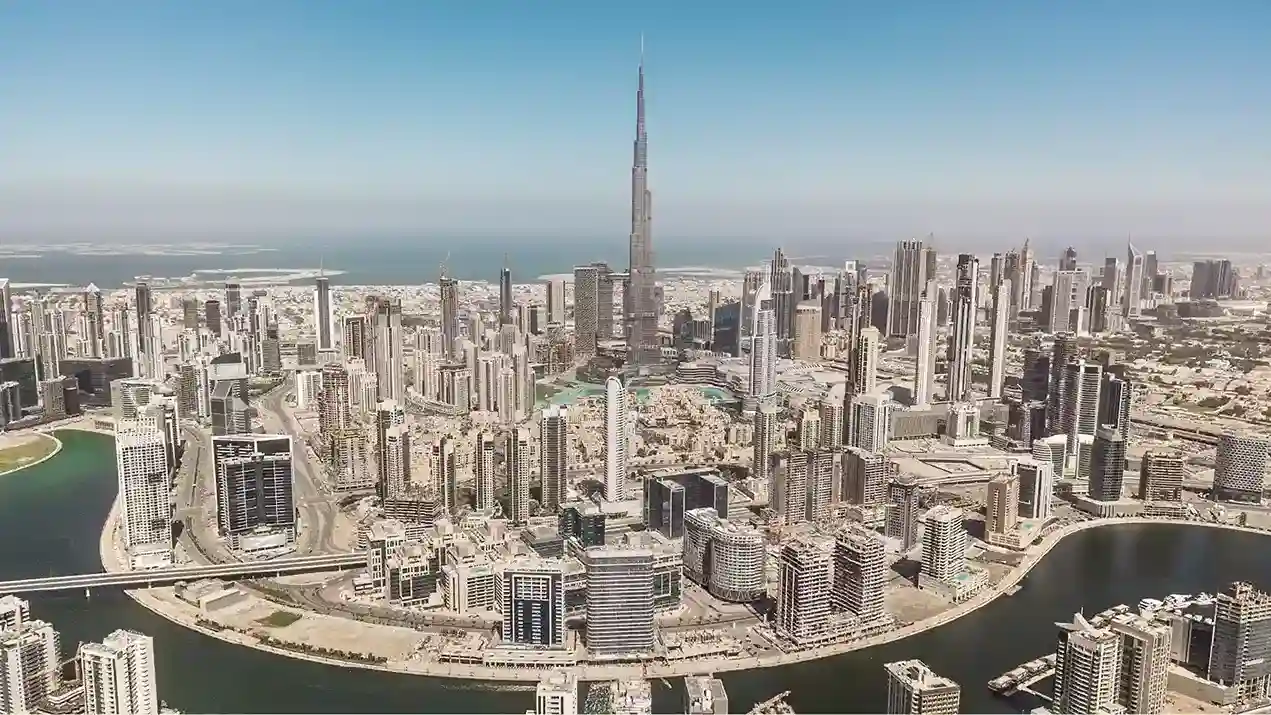
Dubai’s smart infrastructure is built on high-speed digital networks, IoT-enabled systems, and intelligent urban design. Smart buildings, connected utilities, and data-driven city management systems ensure operational efficiency while supporting long-term scalability and innovation across sectors.
Sustainability is deeply embedded in Dubai’s smart city vision. The city continues to invest in renewable energy projects, green building regulations, and environmental efficiency programmes. These initiatives support long-term resilience while aligning with global sustainability goals and climate commitments.
A strong example of this commitment is Wasl Tower, recognized as one of the most sustainable towers in the region, featuring advanced energy-efficient systems, smart façade technology, and integrated green building design principles that significantly reduce environmental impact while enhancing overall building performance.
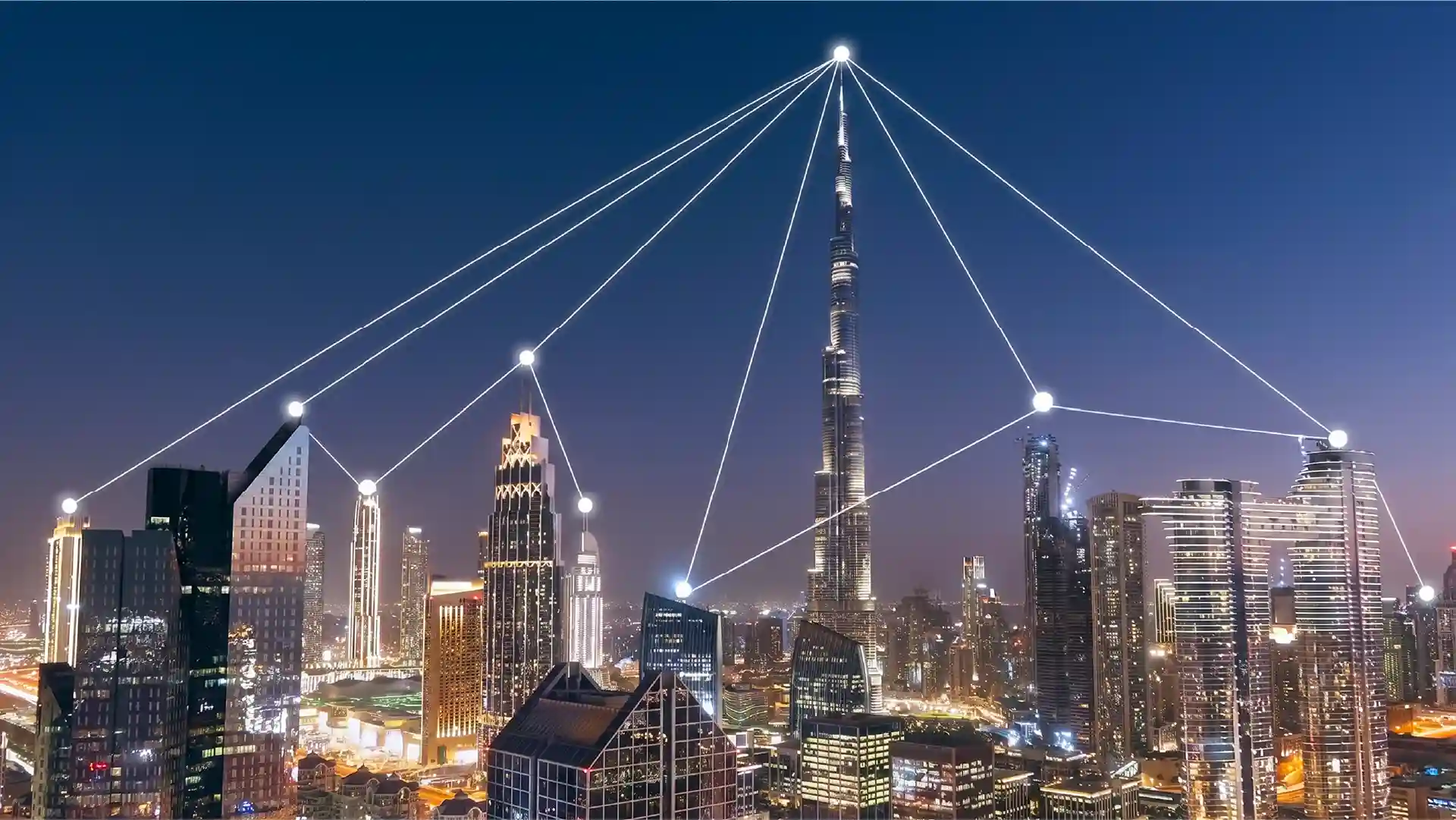
How the IMD Smart City Index Evaluates Cities
The smart city index evaluates cities across multiple dimensions that reflect everyday urban life. The focus is on how technology improves real-world experiences for residents rather than purely measuring infrastructure capacity.
This dimension assesses access to healthcare services, public safety levels, and residents’ confidence in emergency response systems. It reflects how well cities protect and support their populations.
Mobility evaluates the efficiency, reliability, and accessibility of transport systems. It includes public transport quality, traffic management, and the ease of moving around the city.
This area measures the availability of cultural, leisure, and entertainment opportunities. It reflects how cities support lifestyle quality and social engagement.
Opportunities focus on education, employment, entrepreneurship, and economic mobility. Cities are assessed on how well they support personal and professional growth.
Governance evaluates transparency, trust in institutions, and the effectiveness of digital public services. It also considers how engaged citizens feel with their city administration.
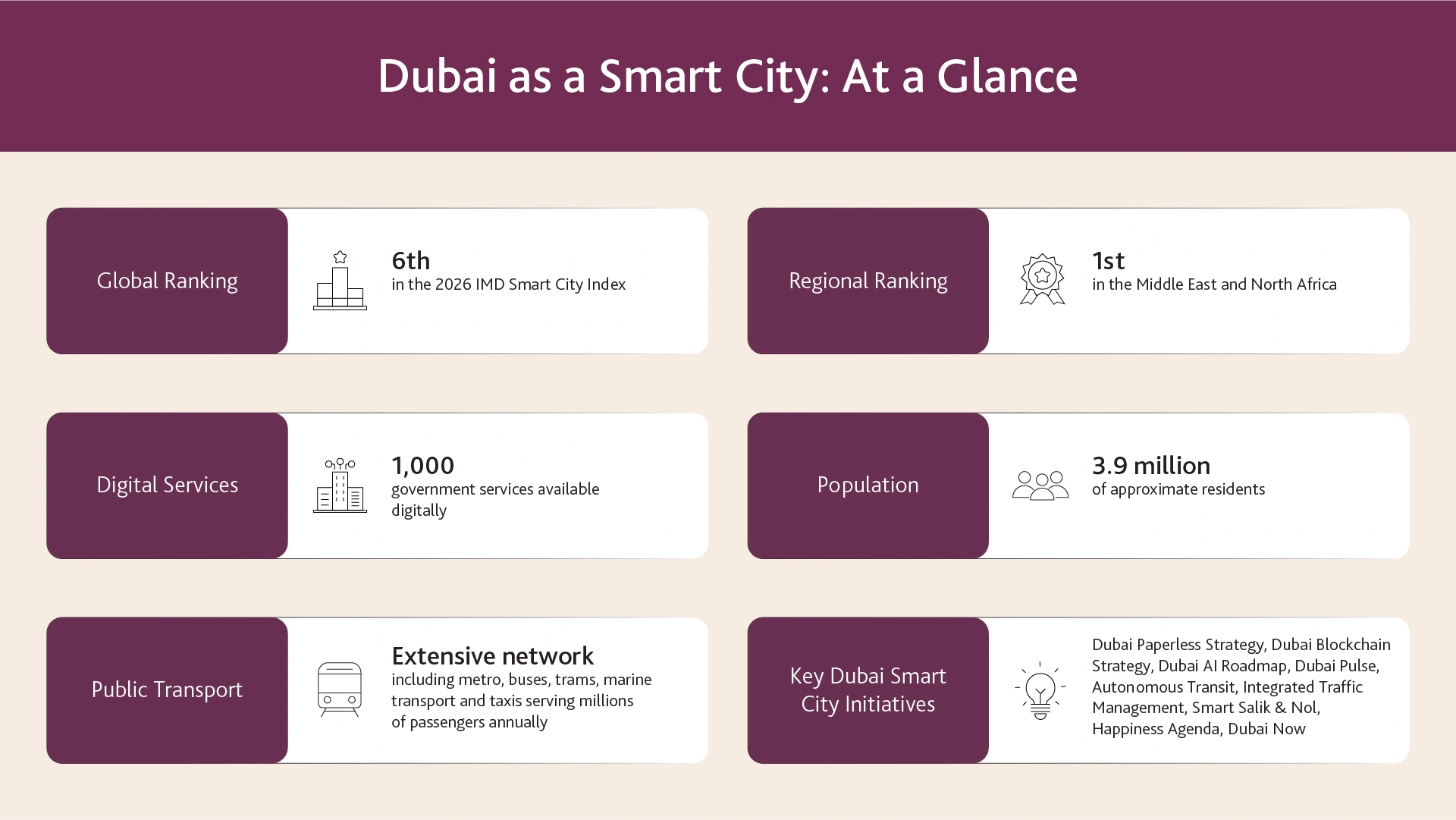
Dubai as a Smart City: At a Glance
Dubai’s performance in the 2026 Smart City Index highlights its position as a global leader in urban innovation.
Together, these elements form the foundation of Dubai’s reputation as one of the world’s most advanced smart cities. [Source: Digital Dubai]
What This Means for Residents, Businesses and Investors
Dubai’s strong performance in the smart city index is not only a recognition of technological progress but also a reflection of tangible benefits across society and the economy.
Residents benefit from seamless access to digital services, improved safety, and enhanced convenience in daily life. Technology integration ensures that essential services are faster, easier, and more responsive.
Government services have become more streamlined and accessible through digital platforms. This reduces administrative complexity and improves overall service delivery efficiency.
Integrated transport systems and smart mobility solutions have significantly improved connectivity across the city. Residents experience reduced travel times and more flexible transport options.
Dubai’s position as a leading smart city strengthens its appeal to global investors and businesses. A digitally advanced environment supports innovation, reduces operational friction, and enhances long-term economic stability.
Smart city development continues to positively influence Dubai’s real estate sector. Well-connected communities with advanced infrastructure are in higher demand, supporting long-term property value growth and reinforcing Dubai’s position as a global investment hub.
Conclusion
Dubai’s ranking of 6th globally and 1st regionally in the 2026 IMD Smart City Index highlights its continued evolution as a world-leading smart city. The emirate’s focus on digital transformation, artificial intelligence, sustainability, and citizen-centric governance has positioned it among the most advanced urban centres globally.
As the smart city index continues to evolve, Dubai’s consistent performance demonstrates that its strategy is not only about technological advancement, but also about building a more efficient, connected, and liveable city for the future.
FAQs
The index evaluates how cities use technology to improve residents’ quality of life across areas such as governance, mobility, health and safety, activities, and opportunities, based largely on citizen perceptions.
Dubai ranked 6th globally and 1st regionally in the 2026 IMD Smart City Index. This achievement reflects its strong progress in digital transformation, smart infrastructure, and innovation-led governance. It also highlights Dubai’s commitment to improving quality of life through advanced public services, sustainable urban planning, and technology-driven city management initiatives.
Zurich secured the top position in the 2026 Smart City Index. The city is recognised for its highly efficient public services, strong digital infrastructure, sustainable urban planning, and high quality of life. Its consistent focus on innovation, mobility, and citizen-centric governance has helped it maintain a leading global position in smart city development.
The top five smart cities in the world are Zurich, Oslo, Geneva, Copenhagen, and Singapore. These cities stand out for different strengths, ranging from highly efficient public transport systems and strong environmental policies to advanced digital governance and consistently high standards of urban living that support both residents and businesses.
Dubai is considered a smart city due to its advanced digital governance, AI integration, smart mobility systems, strong infrastructure, and sustainability-driven urban planning.
Yes, Dubai ranked first in the Middle East and North Africa in the 2026 Smart City Index, making it the region’s leading smart city.