


Image


Rental yields are one of the most useful metrics for assessing the income potential of an investment property. They show the annual rental return a property can generate relative to its acquisition cost, helping investors compare assets, communities and investment strategies.
When evaluating rental property in Dubai and the UAE, it is important to look beyond the headline figure. Gross rental yield provides a quick view of potential rental income, while net rental yield accounts for costs such as service charges, maintenance, management fees and vacancy periods. Understanding both gives investors a more realistic picture of potential returns.
Dubai's diverse property market means rental yields can vary significantly depending on location, property type, purchase price, tenant demand and ongoing costs. The right approach is therefore not simply to look for the highest percentage, but to assess whether the yield is sustainable and aligned with your investment objectives.
Table of Contents
What Is Rental Yield?
Rental yield is the potential return an investor can earn from renting out a property, expressed as a percentage. It measures the annual rental income generated by a property in relation to the amount invested in it. For example, if a property costs AED 1 million and generates AED 70,000 in annual rent, its gross rental yield is 7%.
Rental yield is particularly useful when comparing different properties because a property with a higher purchase price is not necessarily the one that generates the highest rental return. However, investors should distinguish between gross rental yield and net rental yield, as the two figures provide different perspectives on performance.
Gross rental yield measures annual rental income against the property's acquisition price before deducting expenses. It is useful as an initial comparison tool because it allows investors to quickly compare the income potential of different properties or locations. However, gross yield does not account for costs such as:
For this reason, gross yield should be treated as a starting point rather than the final measure of profitability.

Net rental yield provides a more realistic view of an investment's income performance because it takes relevant operating costs into account. For example, two properties could both have a gross rental yield of 7%, but the property with lower service charges and fewer ongoing expenses may produce a higher net return. When deciding between properties, investors should therefore consider both the gross and net figures.
How to Calculate Rental Yield
If you are asking how to calculate rental yield, the process can be broken down into three main steps.
Start with more than just the advertised purchase price. The total acquisition cost may include:
For a more accurate calculation, investors should consider the total amount required to acquire and prepare the property for rental.
Next, estimate how much rent the property can realistically generate over a year. Rather than relying solely on asking for rents, compare similar properties in the same building or community. Consider:
If you expect the property to be vacant for part of the year, factor this into your calculation rather than assuming 12 months of uninterrupted rental income.
The final step is identifying the costs associated with operating the property. Depending on the property and rental strategy, these can include:
These costs are particularly important when calculating net rental yield.

Gross Rental Yield Formula
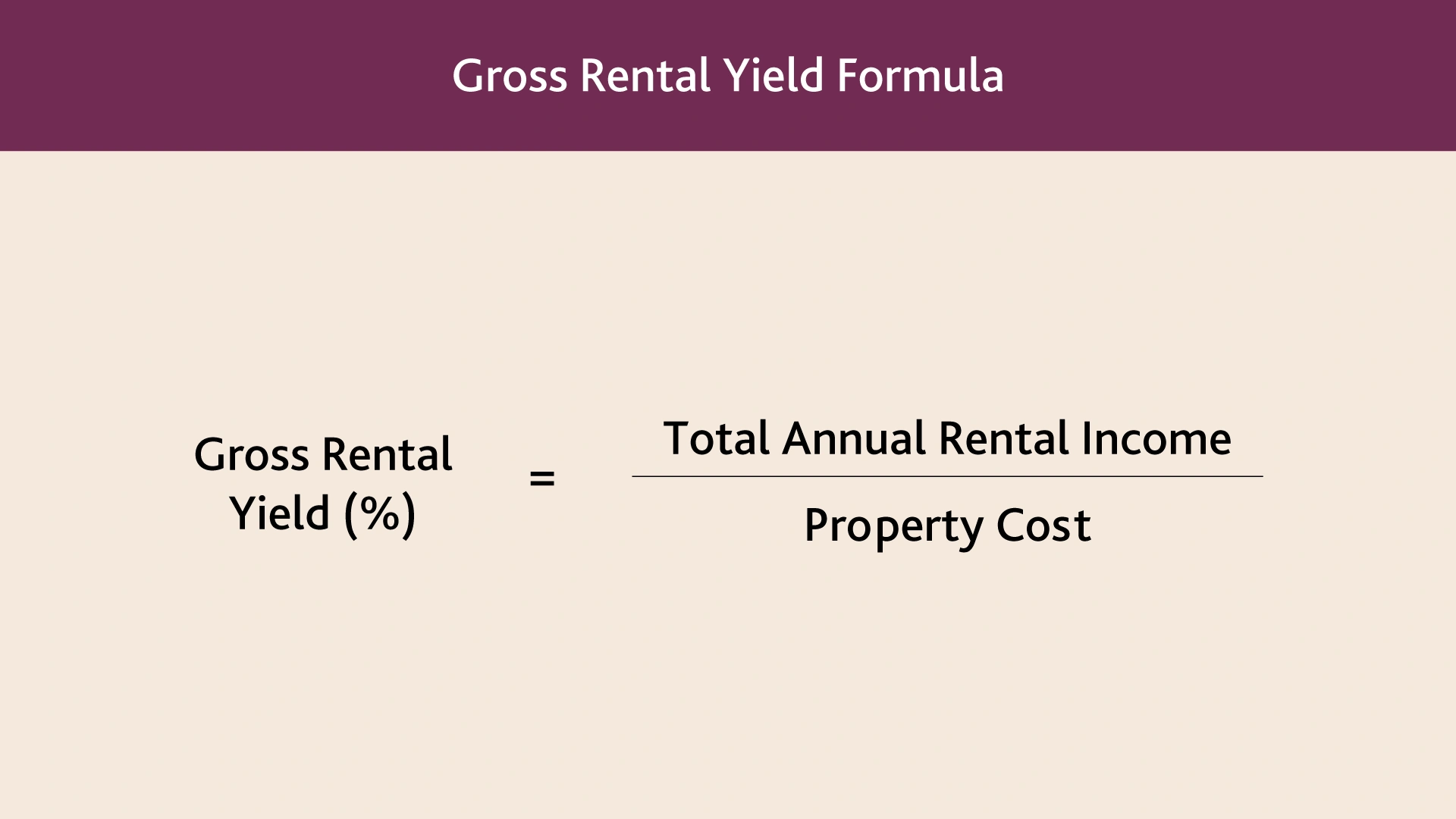
The basic formula to calculate rental yield on a gross basis is:
Gross Rental Yield = (Annual Rental Income ÷ Property Purchase Price) × 100
For example:
Gross Rental Yield = (70,000 ÷ 1,000,000) × 100 = 7%
For a more comprehensive investment analysis, you can replace the purchase price with the property's total acquisition cost.
Net Rental Yield Formula
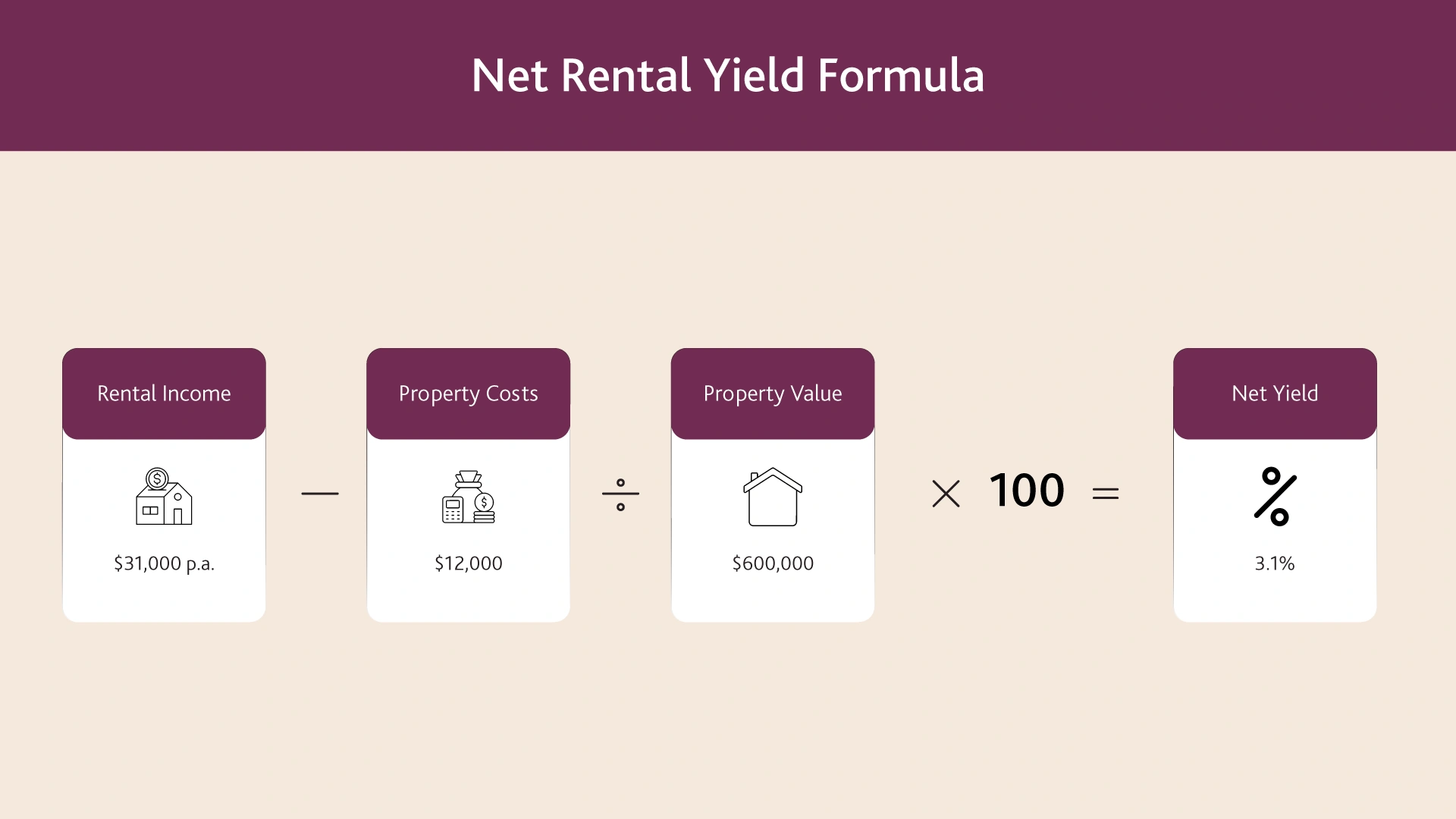
To calculate rental ROI more accurately, investors can account for annual operating expenses.
Net Rental Yield = [(Annual Rental Income − Annual Property Expenses) ÷ Total Acquisition Cost] × 100
For example:
Net Rental Yield = [(70,000 − 12,000) ÷ 1,050,000] × 100 = 5.52%
This illustrates why looking only at gross rental yield can give an incomplete picture of an investment's potential. It is also important to distinguish rental yield from total investment return. Rental yield focuses on rental income, while overall ROI can also include capital appreciation, financing costs, selling costs and other factors.
What Is a Good Rental Yield?
A rental yield of 5% to 8% is generally considered a good range, but there is no one-size-fits-all figure. The right benchmark depends on factors such as the property's purchase price, rental income, ongoing costs, location and tenant demand. A higher yield may indicate stronger rental income relative to the property's price, but it should not be considered in isolation. A property with a lower yield may still offer a compelling investment if it benefits from strong tenant demand, lower operating costs, better liquidity or greater potential for capital appreciation.
In Dubai, rental performance can vary significantly between locations and property types. Investors can use the Dubai Land Department's Rental Index to check average rental values for specific areas and property types, helping them establish a more realistic estimate of potential rental income before calculating yield.
The Dubai rental market has also continued to show strong activity. According to DLD, registered tenancy contracts in 2025 increased by 6% in volume and 17% in value compared with 2024, reaching 1.38 million contracts worth AED 126.4 billion. In Q1 2026, rental contracts reached AED 32.2 billion, with more than 118,000 new contracts and 135,000 renewals recorded.
The better question is therefore:
Does the rental yield provide an attractive and sustainable return relative to the property's price, costs, risk and potential for future growth?

The “Hidden” Variables in Dubai Real Estate
Headline rental yields can look attractive, but several less visible factors can influence the actual return an investor receives.
Service charges can have a meaningful impact on net rental income, particularly in buildings with extensive facilities and amenities. When comparing properties, investors should check the applicable service charges and understand what they cover. A property with a lower purchase price and higher service charges may ultimately generate a lower net yield than a more expensive property with lower annual ownership costs.
The rental strategy can also influence returns. Long-term rentals generally offer greater income predictability and simpler day-to-day management, while short-term rentals may provide the potential for higher revenue during periods of strong demand but can involve additional management, furnishing, cleaning and occupancy considerations. Investors should compare expected income after all associated costs rather than comparing headline rental rates alone.

Key Factors That Affect Rental Yield
Location is one of the most important factors affecting rental income and property prices. Established communities with strong tenant demand can support stable occupancy, while emerging areas may offer lower entry prices and potentially higher yields as communities develop.
Studios and one-bedroom apartments can often have attractive rental yields because of their relatively accessible purchase prices and broad tenant demand. Larger apartments, townhouses and villas may offer different income profiles, with family-orientated properties often benefiting from longer tenancy periods and different demand patterns.
Strong tenant demand can support rental rates and reduce vacancy periods. Before investing, consider who is likely to rent the property and whether the location meets their needs in terms of affordability, lifestyle, employment centres, schools and transport.
Purchase price directly influences yield. If two properties generate AED 70,000 in annual rent but one costs AED 900,000 and the other AED 1.2 million, their gross rental yields will be significantly different. Negotiating the purchase price can therefore have a meaningful impact on the eventual return.
Expenses such as service charges, maintenance, management and leasing costs can reduce the income an investor retains. Always calculate the expected net return before making an investment decision.
Swimming pools, gyms, parking, security, landscaped spaces and other amenities can influence tenant demand. However, amenities can also contribute to service charges, so investors should consider both their rental benefit and their cost.
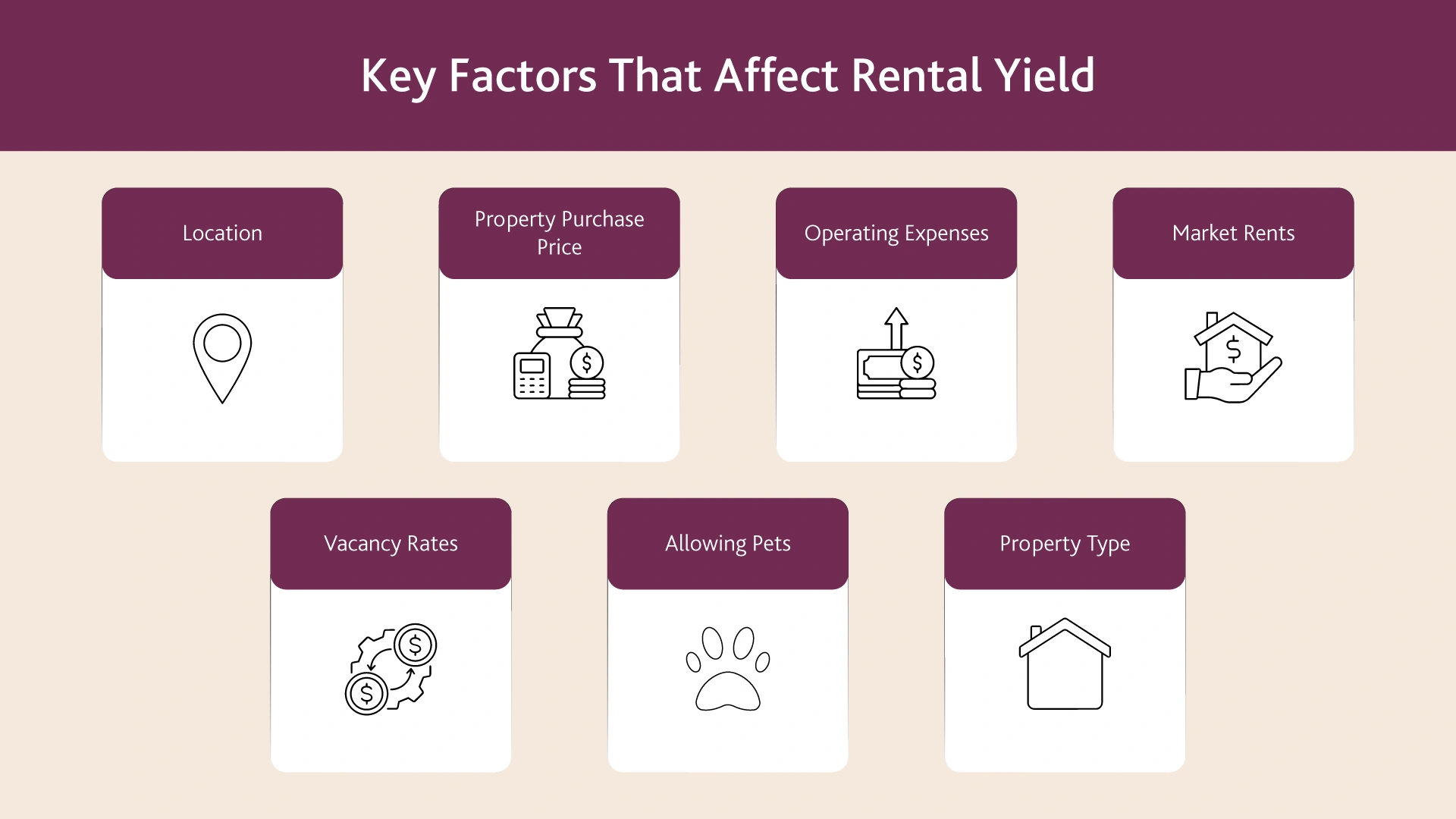
A property's advertised annual rent does not necessarily equal the income actually received. Even a short vacancy period can reduce annual returns. Estimating realistic occupancy is therefore essential when calculating net yield.
Access to major roads, public transport and employment centres can influence tenant demand.
Properties close to metro stations, major road networks and established commercial districts may appeal to a wider tenant pool, depending on the target market.
How to Evaluate a Property’s Investment Potential
Rental yield should be one part of a broader investment assessment. Before purchasing, consider the following:
1. Calculate the total investment: Include the purchase price, transaction costs, furnishing and any initial improvements.
2. Research comparable rents: Look at similar properties in the same building or community rather than relying on broad area averages.
3. Calculate gross yield: Use expected annual rent against the acquisition cost.
4. Calculate net yield: Deduct realistic annual operating costs and account for potential vacancy.
5. Assess tenant demand: Identify the likely tenant profile and determine whether demand is strong and sustainable.
6. Review supply: Consider existing competing properties and planned new developments that could affect rental competition.
7. Assess capital appreciation potential: Rental income is only one part of the investment case. Location, infrastructure, development plans and market conditions can influence future property values.
8. Consider your investment timeframe: A property suited to short-term income generation may not be the same as one designed for long-term capital growth.
9. Stress-test your numbers: Consider what happens if rent is lower than expected, the property remains vacant for several weeks, or an unexpected maintenance expense occurs.
10. Compare the alternatives: Evaluate several properties using the same assumptions before deciding which offers the strongest overall investment case.

Common Mistakes Investors Make When Assessing Yield
1- Focusing only on gross yield: A high gross rental yield can look attractive but may fall significantly after expenses.
2- Using asking rents instead of realistic rents: Advertised rental prices do not always reflect the rent a property will actually achieve. Comparable properties and recent market evidence provide a more reliable basis for estimates.
3- Ignoring vacancy: Assuming 100% occupancy throughout the year can overstate expected income.
4- Underestimating service charges: Service charges can materially affect net returns, particularly in amenity-rich developments.
5- Comparing different property types: Comparing a studio in a mid-market community with a luxury villa based solely on yield can be misleading. The properties have different tenant profiles, costs, liquidity and capital-growth characteristics.
6- Chasing the highest percentage: The highest rental yield is not automatically the best investment. Investors should also consider location quality, tenant demand, property condition, future supply and resale potential.
7- Overlooking purchase price: Even a small difference in acquisition price can significantly change the calculated yield.
8- Ignoring the investment strategy: An investor focused on regular income may prioritise a different property from someone seeking a combination of rental income and long-term capital appreciation.

Market Trends and ROI in Dubai by Location
Dubai's rental market remains active, supported by continued demand for residential properties. According to the Dubai Land Department, registered tenancy contracts in 2025 increased by 6% in volume and 17% in value compared with 2024, reaching 1.38 million contracts worth AED 126.4 billion. Dubai Land Department: Dubai’s rental sector records strong growth in 2025
The market continued to show activity in Q1 2026, when rental contracts reached AED 32.2 billion, with more than 118,000 new contracts and over 135,000 renewals recorded. Dubai Land Department: Dubai’s rental market charts stable trajectory in Q1 2026
However, rental performance can vary considerably between locations, property types and individual buildings. Investors should therefore avoid relying on a single city-wide rental yield when assessing an investment.
The Dubai Land Department's Rental Index can be used to review rental values by location and property type, providing a useful reference when estimating potential rental income. Investors can then compare these rental values with the property's purchase price and expected expenses to calculate rental yield and assess the property's potential return. Dubai Land Department Rental Index
It is also important to distinguish between rental yield and overall return on investment. Rental yield measures income generated from rent, while total ROI may also be influenced by factors such as capital appreciation, financing costs, acquisition expenses and selling costs.
Ultimately, the most attractive location is not necessarily the one with the highest rental yield. Investors should consider rental demand, entry price, occupancy, operating costs, future development and potential capital appreciation when comparing opportunities across Dubai.

Fact Box
Dubai Rental Market at a Glance
Source: Dubai Land Department

Conclusion
Understanding rental yields is an important starting point for evaluating an investment property, but it should never be the only metric used. Knowing what rental yield is, understanding how to calculate rental yield, and distinguishing between gross rental yield and net rental yield can help investors make more informed comparisons between properties and locations.
In Dubai, differences in purchase prices, service charges, tenant demand, occupancy and property type can have a significant impact on actual returns. The most attractive investment may therefore not be the property with the highest advertised yield but the one that offers a sustainable combination of rental income, manageable costs, tenant demand and long-term potential.
By looking beyond the headline percentage and assessing the full investment picture, investors can make more informed decisions and better understand a property's potential within their wider investment strategy.
FAQs
There is no universal figure that defines a good rental yield in Dubai. A yield should be assessed alongside purchase price, operating costs, vacancy, tenant demand, location and potential capital appreciation. Current market data shows that yields vary significantly between communities and property types.
Gross rental yield measures annual rental income against the property's acquisition cost before expenses. Net rental yield deducts relevant costs such as service charges, maintenance, management fees and vacancy-related losses. Net yield generally provides a more realistic view of the income an investor may retain.
No. A high rental yield may come with higher costs, greater vacancy risk, lower liquidity or less potential for capital appreciation. Investors should consider the overall risk and return profile rather than choosing a property based solely on the highest percentage.
For investors focused on rental yield and immediate income, a ready property is generally the better option, as actual rents, occupancy and operating costs can be assessed. Off-plan properties may offer attractive pricing or payment plans, but rental income only starts after completion and future rental performance is less certain.